Loading

Carl & Strups World

The historical timeline – Carl Stülpner and his time

The biographical chronology on the left, the story on the right. Historical context carries its own date without moving the main scale.

Who are you planning for?

The content adapts to your choice.

Use on the projector

From here you can explore the content directly with your class.

Materials to take away

Matching worksheets are at the end of each volume.

Materials to take away

Play, read-aloud and creative materials are at the end of each volume.

Carl Stülpner

Perspective

Historical prelude

Carl Stülpner

1762 — 1832

Scharfenstein · Ore Mountains

17th century

Life in the Ore Mountains

There was silver under the earth; above it, life was sparse. Long winters, hard work and dependence on those who held the land shaped the days of many families. The mine, the forest and the craft gave them what they needed to live.

Teaching material for teachers

Ready-to-use classroom resources

Carl is born.

30 September · Scharfenstein

This is where his life begins.

Volume threshold

01

Volume 01

Der kleine Carl im Rauch der Husaren

Story period · 1762–1779

Submitted for

Swiss Children's and Youth Book Prize German Children's and Youth Book Prize SüdStorch Children's Book Prize

This is where Carl’s story begins – in a world where need, danger and solidarity already show what people mean to one another.

In the book

Context · 1762

Why does this volume matter?

When Carl was born in 1762, the Seven Years’ War was still ongoing.

Saxony and the Ore Mountains were shaped by war and insecurity. Carl grew up as the youngest of eight children in modest circumstances on a Häusler smallholding in Scharfenstein – a small rural holding of the lower classes.

Lordship and property rights shaped the daily life of ordinary people: forest, game and many ways of securing a livelihood were not freely available to them. Volume 01 thus shows the world Carl was born into – and from which much of what would shape his later life can be understood.

Discover knowledge

Burning questions

Evidence

How do we actually know this?

Documented, traditional or narratively compressed: here the source situation for Volume 01 becomes visible – without inventing primary sources.

Historically documented Traditional Artistic condensation

Sources & citations

  • Carl’s family

    Carl is the youngest of eight children.

    Historically documented

    Literature

    Johannes Pietzonka
    Carl Stülpner – Legende und Wirklichkeit
    p. 15

  • The black hussars

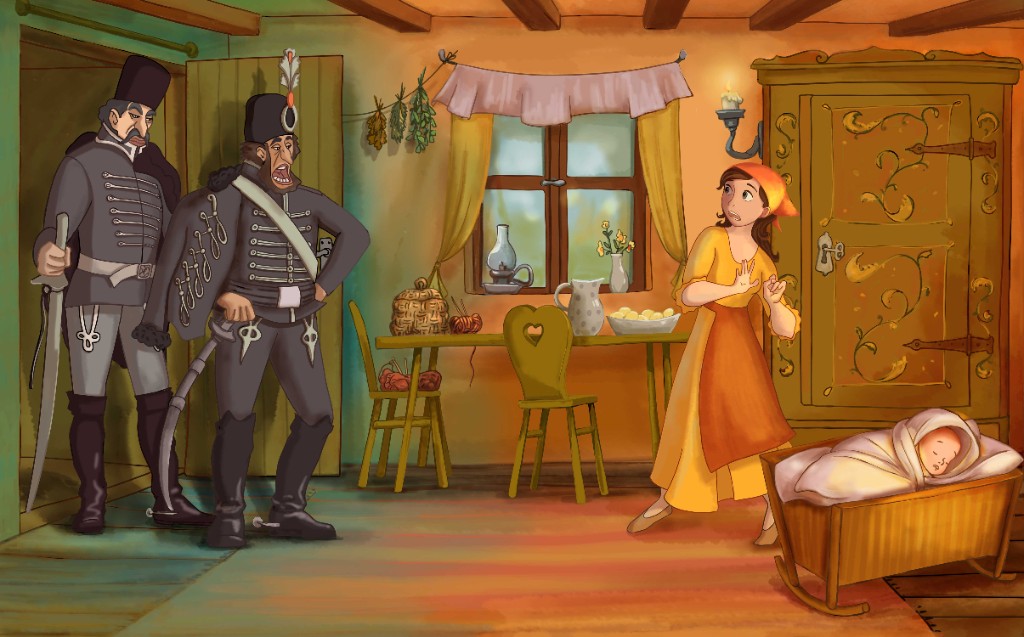
    At the hour of his birth, tradition tells of black hussars.

    Traditional

    Origin of the story

    Schönberg · Stülpner biography

    Historical context

    Independently of that scene, black hussars are attested in the region in contemporary sources. Pietzonka (p. 15) notes excesses by hussars in Großolbersdorf in 1761 and cites the Schönbrunn pastor’s diary on Belling’s black hussar corps.

    Assessment

    The concrete scene at the birth house, by contrast, comes from the Stülpner tradition. Whether these particular hussars stood in front of the Stülpner family house cannot be independently proven.

    Literature

    Johannes Pietzonka
    Carl Stülpner – Legende und Wirklichkeit
    p. 15

  • The scene in the book

    Volume 01 draws the traditional hussar episode into narrative form.

    Artistic condensation

    Basis

    Tradition of the hussar episode.

    Historical frame

    Military presence in the region is historically attested.

    Treatment in the book

    Dialogue, concrete sequences and individual scenic details are narrative shaping.

Teachers ·

Explore further

Go deeper into Carl's world.

History, knowledge and materials — for your perspective.

Entry

A family is in danger.

Volume 01 leads into Carl’s childhood and a time when war still shaped everyday life for many families after the fighting had ended.

The story of the hussars offers an immediate way in: What happens to a family when foreign soldiers suddenly stand at the door?

For the entry

  • read aloud a selected book scene
  • gather together: What frightens Carl?
  • ask: What would you do in Carl’s place?

Discover

What do we know – and what do we tell?

Children meet Carl’s story not only as adventure. They can also discover what is historically documented, what is handed down, and what was shaped for the book.

Historically documented Traditional Artistic condensation

This makes visible how a told story can grow from historical traces.

Discover together

  • Why did soldiers come into villages and houses?
  • What did war mean for families in the Ore Mountains?
  • Which parts of Carl’s story can we document?

Deepen

Carl was not the only one who was afraid.

The volume opens space to talk about fear, responsibility, family and mutual help.

The story should not split into “good” and “evil”. Ordinary soldiers also lived under orders, dependencies and the consequences of their time.

Think further

  • What helps people when they are afraid?
  • Why is mutual help important?
  • Can someone frighten others and still be afraid themselves?
  • What changes when we try to understand the other person’s situation?

Materials to take away

Material for:

These materials may be printed, copied and adapted for your own class or kindergarten group.

  • Background brief PDF

    Life in the Ore Mountains before Carl

    A compact framing of everyday life, dependencies and living conditions before Carl’s birth.

    Download PDF 69 KB
  • Background brief PDF

    Background: The Ore Mountains in Carl’s time

    A compact historical framing of war, everyday life, social conditions and Carl’s world.

    Download PDF 52 KB
  • Worksheet PDF

    Worksheet Volume 01

    Tasks on the book story, historical context, perspectives and reading comprehension.

    Download PDF 35 KB
  • Teaching prompts PDF

    Volume 01 in class

    Concrete teaching paths for 20 minutes, 45 minutes or a deeper double period.

    Download PDF 36 KB
  • Source sheet PDF

    Documented, handed down or told?

    An age-appropriate entry into source criticism and the series’ three evidence levels.

    Download PDF 43 KB
  • Teacher overview PDF

    Volume 01 – teaching at a glance

    Learning goals, themes, time needs, uses and materials summarised compactly.

    Download PDF 48 KB
  • Read-aloud material PDF

    Carl and the foreign riders

    A short entry for reading aloud, looking and telling together.

    Download PDF 31 KB
  • Conversation prompts PDF

    Fear, courage and help

    Short conversation ideas for circle time about feelings, courage and mutual help.

    Download PDF 31 KB
  • Play & discover PDF

    Traces, sounds and a safe path

    Three simple activities on perception, orientation and mutual help.

    Download PDF 32 KB
  • Creative material PDF

    My courage shield

    A simple black-and-white activity for colouring, telling and discovering together.

    Download PDF 28 KB
  • Companion sheet PDF

    Volume 01 – at a glance

    Goals, themes, time needs, uses and materials for early-years educators.

    Download PDF 34 KB

Volume exit

Bridge to the next volume

Prices are rising.

Grain and stores grow scarce. The dearth moves through Saxony and the Ore Mountains.

Hardship deepens.

Scarcity and hunger reach the region clearly. Carl is about nine years old.

Volume threshold

02

Volume 02

Winter der Teuerung – Carl und der Schweinetrog-Pirat

Story period · 1770–1772

Submitted for

Swiss Children's and Youth Book Prize German Children's and Youth Book Prize

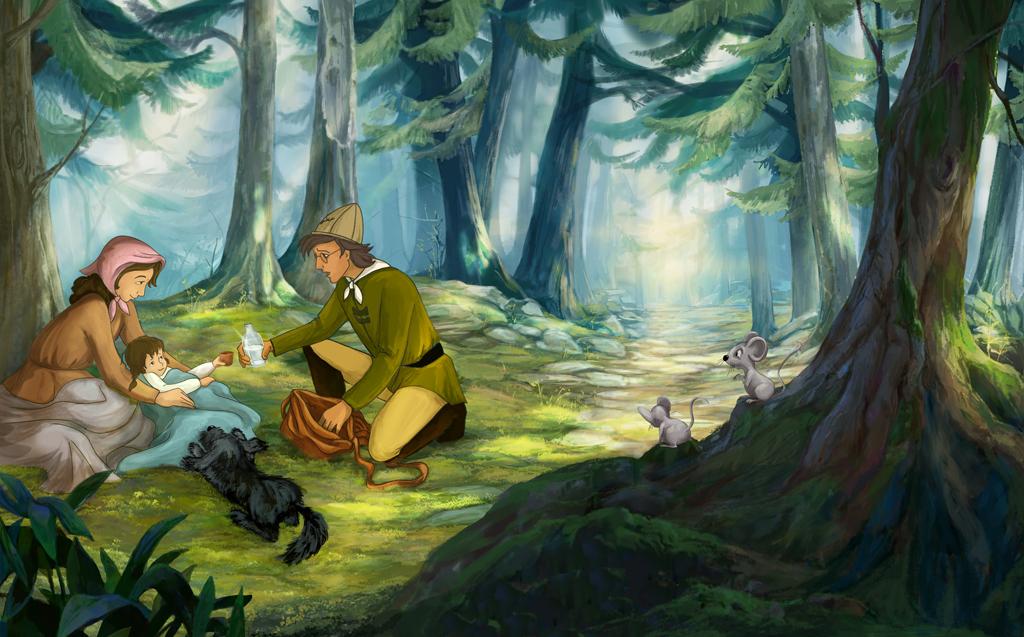
After winter, people in the Ore Mountains still lack almost everything. Carl meets that hardship and begins to help.

In the book

Context · 1770–1772

Why does this volume matter?

Carl is still a child when the Ore Mountains are struck by a severe famine and period of soaring prices.

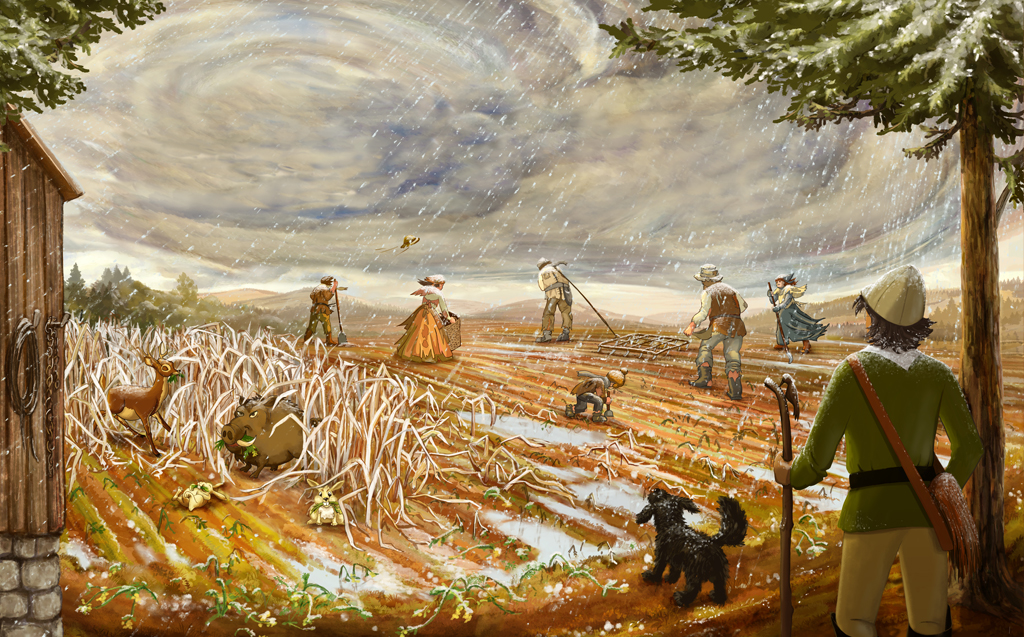
In 1770 a series of unusual weather events and poor harvests begins. In 1771 the harvest is destroyed again. Grain and bread prices rise dramatically. At the start of 1772, the ban on Bohemian grain exports makes matters even worse. Rising prices turn into hunger.

People sell their belongings, search the fields for anything edible and boil grass into mash. Disease spreads among the weakened population. Many die. Others leave their homes and take to the country roads.

Scharfenstein and Carl's family are not spared either.

Volume 02 therefore does not simply show a harsh winter or a poor harvest. It shows a time in which Carl experiences how quickly poverty can turn into hunger – and how important it is not simply to leave a person in need lying there.

These experiences belong to the formative years of his childhood and help us understand why justice, helping others and an eye for other people's hardship could play such a large part in his later life.

Discover knowledge

Burning questions

Evidence

How do we actually know this?

Documented, traditional or artistically condensed: here the state of the sources for Volume 02 becomes visible – without invented primary sources.

Historically documented Traditional Artistic condensation

Sources & citations

  • The weather

    Unusual weather events accumulate in 1770 and 1771.

    Historically documented

    Historical context

    Pietzonka names specific weather events: in 1770, thunderstorms in January, flooding of the Zschopau, snow from 18 to 22 March and a wet summer. In 1771, a mild winter, ploughing as early as February, snow in May and then rain right into August.

    Assessment

    In Pietzonka, this sequence of weather is directly linked to the poor harvests and the onset of rising prices.

    Literature

    Johannes Pietzonka
    Carl Stülpner – Legende und Wirklichkeit
    p. 19-20

  • Prices and hunger

    Grain and bread became extremely expensive within a short time.

    Historically documented

    Evidence

    Pietzonka gives concrete prices for grain, wheat, barley, oats and bread between January 1770 and June 1772. Example, grain: January 1770 – 1 thaler 12 groschen per scheffel; July 1771 – 10 thalers; June 1772 – 13 thalers 15 groschen.

    Historical context

    For 1770, Pietzonka gives an average daily wage of 4 groschen.

    Assessment

    This makes the scale of the price rises directly understandable. Staple foods became increasingly unaffordable for poor families.

    Literature

    Johannes Pietzonka
    Carl Stülpner – Legende und Wirklichkeit
    p. 19-20

  • The great migration

    During the famine, people left their homes and their families.

    Historically documented

    Historical context

    Pietzonka describes children begging for bread, people selling their belongings, and starving people eating grass, tree bark and roots. He then reports on the “great migration”: old people leave their children, children leave their parents. Hundreds take to the country roads.

    Assessment

    The wandering, weakened people in the children's book therefore stand within a historically documented setting. The specific characters and encounters of the children's book, however, remain artistic shaping.

    Literature

    Johannes Pietzonka
    Carl Stülpner – Legende und Wirklichkeit
    p. 20-21

  • Scharfenstein

    The high mortality is documented for Carl's immediate home.

    Historically documented

    Evidence

    Pietzonka reports from the register of deaths for Großolbersdorf. By 18 July 1771, 75 deaths of that year had already been buried. After that the register breaks off. For 1772, Pietzonka gives 154 deaths. For 1774: 21 deaths.

    Historical context

    For 18 July 1771, Pietzonka cites the note that no more bearers can be found and that the corpses are being taken away by the gravedigger in a wheelbarrow.

    Assessment

    The famine is thus tangible not only in general terms for Saxony or the Ore Mountains, but directly for Carl's own surroundings.

    Literature

    Johannes Pietzonka
    Carl Stülpner – Legende und Wirklichkeit
    p. 21-22

  • Carl's father

    Johann Christoph Stülpner may have fallen victim to the famine.

    Traditional

    Assessment

    This is a historically reasoned conclusion by Pietzonka, but not clear proof of the specific cause of death.

    Basis

    Pietzonka writes that one can say “in all probability” that Carl's father, Johann Christoph, became a victim of the famine.

    Literature

    Johannes Pietzonka
    Carl Stülpner – Legende und Wirklichkeit
    p. 22

  • The scenes in the book

    Volume 02 condenses the historical famine into Carl's story.

    Artistic condensation

    Basis

    Historically documented are the weather, crop failures, rising prices, hunger, disease, high mortality and the migration of the population.

    Historical frame

    Pietzonka's account describes precisely the world in which the young Carl lived during these years.

    Treatment in the book

    The specific encounters, dialogues, Strups's role and individual sequences of events in the children's book are artistic shaping. The historical conditions are not invented as a result – the story makes them tangible for children.

Teachers ·

Explore further

Go deeper into Carl's world.

History, knowledge and materials — for your perspective.

Entry

What would have to happen for bread to become very expensive all of a sudden?

Volume 02 opens the famine and dearth years 1770–1772. First gather ideas: weather, harvest, prices, supply — what is connected?

Then open the historical situation: several poor harvests and rising grain prices change life for poor families in the Ore Mountains.

For the opening

  • Put the question in the room: Why does bread become expensive?
  • Collect and sort ideas on the board
  • Open a short book scene or timeline station

Entry

What do we need every day?

In circle time gather: food, water, warmth, home. Then the question: What happens when food runs short?

Volume 02 tells of a time when the weather spoiled the harvest and many people had little to eat. No scare stories — calm shared thinking.

For the opening

  • What do people need every day?
  • Where does our food come from?
  • What do we do when someone needs help?

Discover

Make the chain of effects visible

Develop together: unusual weather → poor harvest → less grain → higher prices → hunger → illness / migration.

Historically documented Traditional Artistic condensation

Distinguish along the way: What is historically documented — and what is narratively designed in the children’s book?

Discover together

  • Why did a poor grain harvest hit poor families especially hard?
  • Which stages of the chain can you document?
  • Which book scene makes the hardship vivid without itself being evidence?

Discover

From grain to bread

Very simply: Grain grows in the field. Kernels are ground. Bread can be made from flour. If little grows in the field, there is less flour.

Historically documented Traditional Artistic condensation

The hardship in the book is tied to a real historical time. The individual adventures with Carl are told.

Discover together

  • What grows in the field?
  • How does grain become bread?
  • Why do sharing and helping matter?

Deepen

Separate frame and scene

Pietzonka gives weather, price and mortality figures. The children’s book tells concrete encounters from that.

Learning goals: Pupils can explain why several poor harvests can lead to hunger; describe the link weather → harvest → price → hunger; understand that children were more closely bound into everyday work; distinguish historical fact from narrative design; place simple historical source references.

Think further

  • What belongs to the historical frame?
  • What is a narrated scene?
  • Why does the distinction matter?
  • How can we place source references in an age-appropriate way?

Deepen

Carl sees that someone needs help

Carl cannot change the weather. But he can help. Talk about what small help can mean.

No dramatic hunger scenes. Themes stay: weather, food, sharing, helping, where bread comes from.

Think further

  • What can you do when someone needs help?
  • Does help have to be big?
  • How does it feel to share?
  • What makes a good home?

Materials to take away

Material for:

These materials may be printed, copied and adapted for your own class or kindergarten group.

  • Background brief PDF

    Why Did Bread Suddenly Become So Expensive?

    Rising prices and hunger in the Ore Mountains, 1770–1772 – historical background for kindergarten and school.

    Download PDF 54 KB
  • Background brief PDF

    The Years of Dearth, 1770–1772

    Background knowledge on crop failures, rising prices, hunger, migration and Carl’s historical world.

    Download PDF 46 KB
  • Teacher overview PDF

    Volume 02 in the Classroom

    Teaching guidance with learning goals, an introductory activity, sensitive themes and suggestions for using the historical timeline.

    Download PDF 49 KB
  • Teaching prompts PDF

    Discovering and Exploring Volume 02

    Lesson ideas on weather, harvests, prices, food supply, sources and the Ore Mountains as a living environment.

    Download PDF 42 KB
  • Worksheet PDF

    When Bread Keeps Getting More Expensive

    Worksheet on cause and effect, historical classification and why small acts of help can still matter.

    Download PDF 42 KB
  • Source sheet PDF

    Sources on the Years of Dearth and Hunger

    Selected historical information on prices, weather, food supply and hardship, with source-critical questions.

    Download PDF 51 KB
  • Companion sheet PDF

    Guide – Volume 02

    Guidance for working with Volume 02, including themes, aims and age-appropriate ways to approach hunger and hardship.

    Download PDF 51 KB
  • Read-aloud material PDF

    When Bread Becomes Precious

    A short read-aloud introduction to the years of dearth and hunger, with simple questions for the group.

    Download PDF 44 KB
  • Conversation prompts PDF

    Talking about Little, Enough and Sharing

    Child-friendly conversation prompts about food, sharing, weather, helping and sticking together.

    Download PDF 41 KB
  • Play & discover PDF

    From Grain to Bread

    Four simple discovery activities about food, weather, basic needs and small acts of help.

    Download PDF 35 KB
  • Creative material PDF

    Carl’s Supply Basket

    Draw, choose and explain: what does a family really need during a difficult winter?

    Download PDF 33 KB

Volume exit

Bridge to the next volume

The years of famine leave deep scars.

The worst of the hardship begins to ease. But many families in the Ore Mountains have lost relatives, property and their economic security.

Carl loses his father.

Pietzonka considers it highly likely that Johann Christoph Stülpner died during the famine.

A new chapter begins for Carl.

His path leads to Ehrenfriedersdorf.

Volume threshold

03

The journey continues

Volume 03 · In progress

Der Förster und der Junge, der alles sehen wollte

Early summer 1773 · Ehrenfriedersdorf · Greifensteine

Carl is about eleven years old. His path leads him to forester Müller – and into a world where there is ever more for him to discover.

Coming soon

Cart

Your cart is empty.